Navigating AI in the Classroom
I still remember the day that I first heard about AI. I was beginning a unit for high school seniors, teaching them to create their own website for a passion project. A student showed me this “new thing” that was coming out that would create a website in minutes. When he showed me what this rough version of AI looked like, I was completely demoralized. What was the point of my assignment? What sense is there for authentic writing like blog posts? What will I do in class for the next four weeks? This was my first AI crisis moment.
If you're feeling a bit overwhelmed by the whole AI situation, you're not alone. But here's the good news: with clear guidelines and a framework for responsible use, we can actually harness AI as a powerful teaching and learning tool.
The Four-Level Framework: Your AI Roadmap
Think of AI integration as a spectrum rather than an all-or-nothing proposition. FCSD's AI rubric breaks it down into four distinct levels, and honestly, this framework is a game-changer for setting clear expectations.
AI Free (Red Light): Sometimes, you just need students to do the work themselves—no shortcuts, no assistance. This is where students demonstrate mastery using only their own knowledge and skills. Perfect for assessments where you're measuring what they actually know.
AI Assisted (Yellow Light): This is your brainstorming buddy zone. Students can use AI for specific tasks like generating ideas, getting feedback, or planning their approach. The key? No AI content makes it into the final submission. Think of it as using training wheels that come off before the big race.
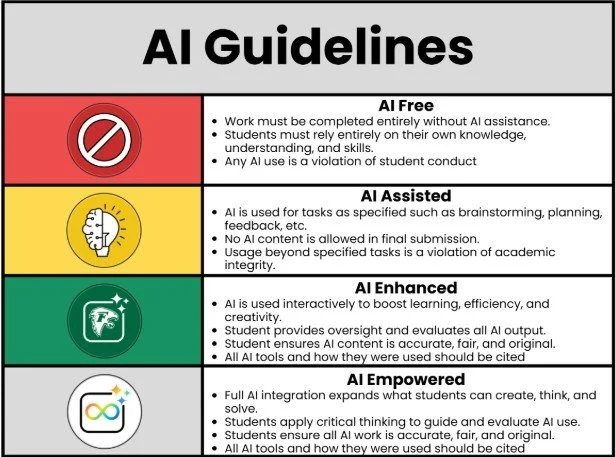
AI Enhanced (Green Light): Now we're cooking! Students can use AI interactively to boost learning, efficiency, and creativity. But here's where responsibility kicks in—students need to oversee and evaluate all AI output, ensure accuracy and originality, and cite every tool they use. This is where critical thinking meets cutting-edge technology.
AI Empowered (Rainbow Light): Full integration mode. Students are using AI to expand what they can create, think, and solve. They're applying critical thinking to guide their AI use, evaluating everything for accuracy and fairness, and—you guessed it—citing all their sources. This is where students become true digital citizens.
Let's Talk About Citations
Adding another citation format to teach might make you want to pull your hair out, but modeling proper AI citation is crucial for teaching digital integrity.
For AI Assisted Work: Keep It Simple
Just add a quick disclosure statement:
"I used Gemini 2.5 to brainstorm initial ideas for this project."
"NotebookLM"
For AI Enhanced and Empowered Work: Go Formal
Here's the format your students need:
AI Company Name. (Year, Month Day). Title of chat [Generative AI chat]. Tool Name. URL.
Real example: Google. (2025, February 1). Tips for citing AI in APA style [Generative AI chat]. Gemini. https://gemini.google.com/share/unique-chat-link
Pro tip: Have students track these five things for every AI interaction:
The exact prompt they used
AI tool name and version (ChatGPT 4.0, Gemini 2.5, etc.)
Company name (OpenAI, Google)
Date of generation
URL or shareable link
Teacher Self-Disclosure: Practice What You Preach
Here's where we lead by example. When you use AI to create materials—and let's be real, it's a massive time-saver for lesson planning—be transparent about it.
Verify accuracy first. AI can sound convincing while being completely wrong. Always fact-check before sharing with students.
Add simple acknowledgments to your materials:
“When you model this transparency, you’re teaching students that using AI isn’t cheating—it’s about using tools responsibly and giving credit where it’s due.”
"Quiz questions generated by Gemini 2.5 and edited by Ms. Johnson"
"Header image created using Gemini 2.5 with the prompt: 'cartoon rocket ship in front of a blue nebula'"
The Bottom Line
AI isn't going anywhere, and pretending it doesn't exist won't help our students navigate their digital future. Instead, we can teach them to use these tools thoughtfully, critically, and ethically.
Start by choosing which level of AI use makes sense for each assignment. Communicate those expectations clearly. Model proper citation and disclosure. And remember—you're not just teaching content; you're teaching digital citizenship for a world that's changing faster than any of us expected.