Sparking Curiosity with SchoolAI
Every teacher loves the moment when a room full of six-year-olds is practically a hive of activity, with hands flying up, voices full of "Wait, did you know?” and everyone talking over one another. That moment is hard to come by, especially when you are introducing new content.
This is what took place, along with a guide on how to replicate it with your own students.
What Is a SchoolAI Space, Anyway?
If you're not familiar with SchoolAI, here's the quick version: a Space is a custom AI chatbot that's been purposefully designed around a specific topic, set of standards, or learning objectives. Think of it like giving your students access to a knowledgeable conversation partner who only talks about the things you want them to explore. Students are free to ask questions after you establish the direction, the boundaries, and the tone.
It's not a free-for-all internet search. It's a guided, safe, age-appropriate experience where kids can dig into content in their own words, at their own pace, driven entirely by their own questions.
The Ocean Discovery Space
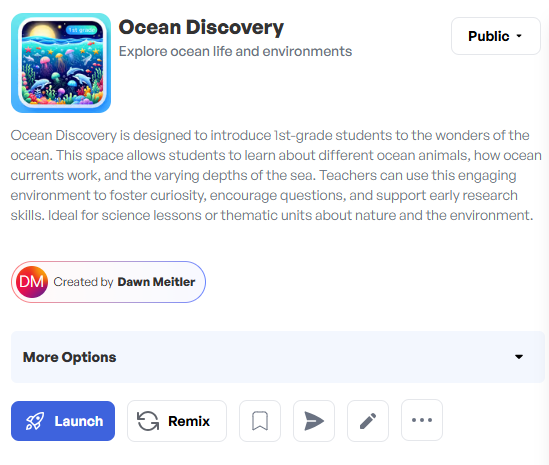
I set up a Space called Ocean Discovery with a simple goal: introduce 1st graders to the world beneath the waves before they officially started their oceans unit. The student-facing description read:
"Dive into the ocean! Explore cool animals, learn about waves and currents, and discover what lives deep down in the sea."
I didn't give them a worksheet. I didn't front-load them with vocabulary. I just pulled up the Space, told them they could ask it anything about the ocean, and let them go.
What Happened in the Room
Honestly? It was a little chaotic in the best way.
In a matter of minutes, children were discussing whether a blue whale could fit in the gym, gasping at facts about anglerfish, and asking follow-up questions like "Why don't fish drown?" What would happen if you fell into the Mariana Trench?
Some students went straight for the animals. Others surprised me by asking about storms, ships, and what the ocean floor looks like. One kiddo spent the whole time asking about bioluminescence after stumbling onto it by accident. She had never heard the word before. By the end, she was spelling it out loud for her tablemates.
When I pulled them to the carpet to officially kick off our oceans unit, I didn't have to do much. The room came alive on its own.
Why This Works: Curiosity Comes First
What I did that day was based on a well-established fact about how children learn, so it was more than just a fun tech exercise.
““Curiosity is the engine of intellectual achievement.””
Researchers like Marianne Stenger have shown that curiosity is a motivator for learning rather than merely a personality characteristic. People who are curious exhibit increased activity in the brain's reward circuits and are better able to remember both the information they were curious about and irrelevant information they came across along the way, according to a widely cited 2014 study by Gruber, Gelman, and Ranganath that was published in Neuron. In other words, curiosity primes the brain to learn about additional topics besides the one being studied.
Students who come to class with a lot of questions are active participants seeking answers rather than passive consumers of knowledge. The Space gave them that head start.
The Magic Is in the Sequence
Here's the move I'd encourage you to try: let the exploration come before the instruction.
Most of the time, we introduce a topic and then invite questions. Flip it. Give students a space to explore first; there are no rules or correct answers; they should just have fun. Then bring them together.
When I gathered my first graders on the carpet, I didn't open with a book or a slideshow. I asked one question: "What's something that surprised you?"
Twenty hands went up. Twenty kids had something to say. And every single answer was a doorway into the content I was about to teach.
Tips for Setting Up Your Own Space
If you want to try this with your class, here are a few things that made it work:
Keep the description inviting and open-ended. You want kids to feel like they can ask anything, not like they're taking a quiz.
Let them explore freely for 10–15 minutes before any discussion. The goal is their curiosity, not yours, so don't interfere too much or hover over them.
Prepare a basic structure for share-out. "What surprised you?" or "Is there anything you'd like to learn more about?" A good question is one that connects exploration and education.
Make use of what they found. Throughout the unit, refer to the questions that students have asked. It conveys to children that their curiosity counts.
A Small Concept with a Huge Benefit
I've been a teacher long enough to know that half the fight is won when students are enthusiastic about a subject. My students didn't learn everything there is to know about oceans from the Ocean Discovery Space; that will be covered in the coming weeks. However, it accomplished something equally important: it piqued their curiosity.
And honestly? That's where all the best learning starts.
Want to try SchoolAI Spaces in your classroom? Visit schoolai.com to learn more and start building your own.