Beyond the Final Answer: How Snorkl Captures Student Thinking
In an age where answers are instantly accessible and artificial intelligence can generate solutions in seconds, the true goal of education is no longer just finding the right answer, it’s developing the ability to think. Today’s students must learn how to explain their reasoning, defend their ideas, and analyze problems from multiple perspectives. Tools like Snorkl support this shift by capturing not just what students know, but how they think. When students articulate their thinking, reflect on their strategies, and engage with the reasoning of others, learning becomes deeper, more meaningful, and far better aligned with the skills they need for the future.
What's Snorkl All About?
Think of Snorkl as your classroom's new secret weapon for understanding how students actually think. It's an AI-powered tool that lets students record their voice and show their reasoning as they work through problems. No more wondering "How did they get this answer?" because you'll literally hear them talk through it.
The best part? Snorkl doesn't just collect these recordings and leave you to sort through hours of audio. It uses AI to give personalized feedback and differentiated support to each student. It's like having a teaching assistant who can be in 30 places at once.
Here's what Snorkl brings to the table:
Student Engagement - When kids know someone's "listening" to their thinking, they tend to think more carefully
AI Feedback - Instant, personalized responses that actually help students improve
Class Insights - Quick snapshots of who gets it and who needs more support
Confidence Building - Students get better at explaining their reasoning over time
Seeing it Through Student Eyes
Picture this: Your high school chemistry students are tackling a problem about calculating average atomic mass for potassium isotopes. Instead of just submitting "39.09 amu" and moving on, they're recording their screen and voice as they work through the problem.
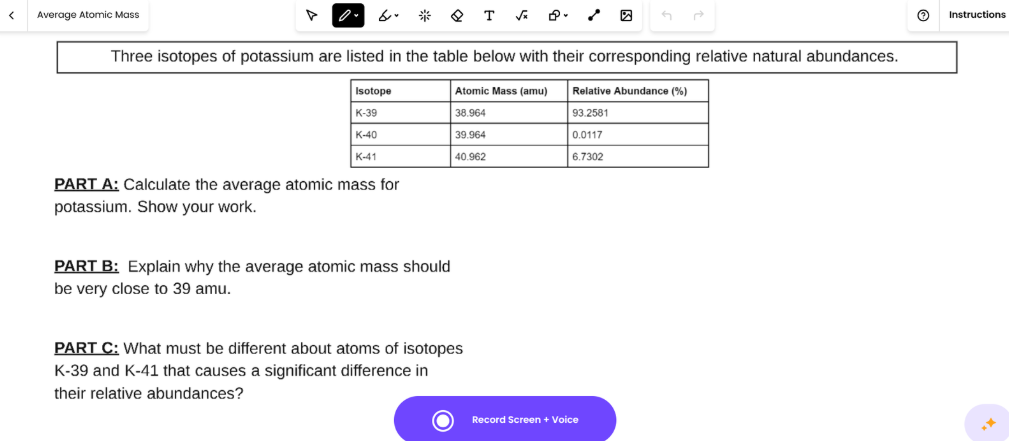
They explain why K-39 is so abundant compared to K-40 and K-41. They show their calculations. They catch their own mistakes. And Snorkl is there capturing all of it, giving them feedback, and helping them refine their thinking.
What Teachers Actually See
From your end, you get a beautifully organized class view showing all student responses. You can filter by "Best Try," "Latest," or "All" attempts. Each response shows:
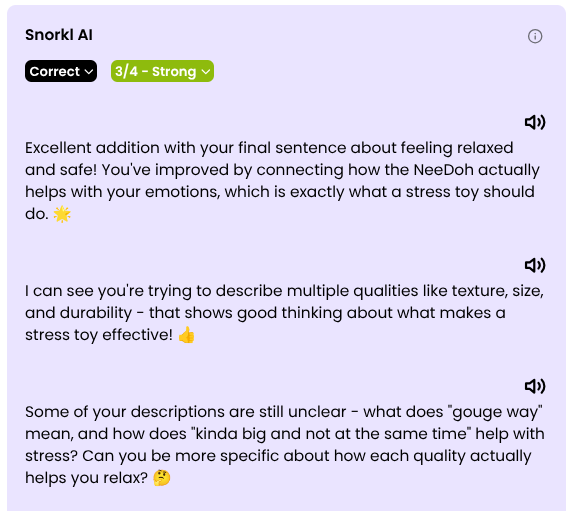
How long students spent on the problem
Whether they got it correct or incorrect
AI-generated feedback ratings like "Excellent," "Strong," "Fair," or "Not Yet"
The actual recording so you can hear their reasoning
about:The Snorkl Library: Your New Best Friend
Not sure where to start? Snorkl has a library packed with ready-to-go activities across different subjects and grade levels. You can browse activities, try them out as a student, and then assign them to your class with a click.
Want to customize? No problem. You can add activities to your personal library to share with other teachers or duplicate and modify them to fit your specific needs.
Why Thinking Matters
Here's the thing: education isn't just about getting the right answer. It's about developing the thinking skills to get there. Snorkl teaches students how to develop thinking skills.
When students explain their reasoning out loud, they're practicing metacognition. When they get immediate, personalized feedback, they can adjust their thinking in real time. And when you can see patterns across your whole class, you can tailor your instruction more effectively.
It's formative assessment at its best.
Getting Started
Ready to try it out? Snorkl offers premium access for schools, but many features are available in the free version. The platform is designed to be intuitive, so you won't need a week of professional development to figure it out.
Start small. Pick one activity from the library. Try it yourself first so you know what your students will experience. Then assign it to a class and see what happens. You might be surprised by what you learn about your students' thinking.
Because at the end of the day, that's what teaching is really about, understanding how our students think so we can help them think even better.